How to Sync Multiple Live Streams for Esports Analysis
Tired of desynced streams? Learn how to sync multiple live streams for superior esports analysis using ViewGrid.tv. Get multi-POV sync and reduce stream delay.
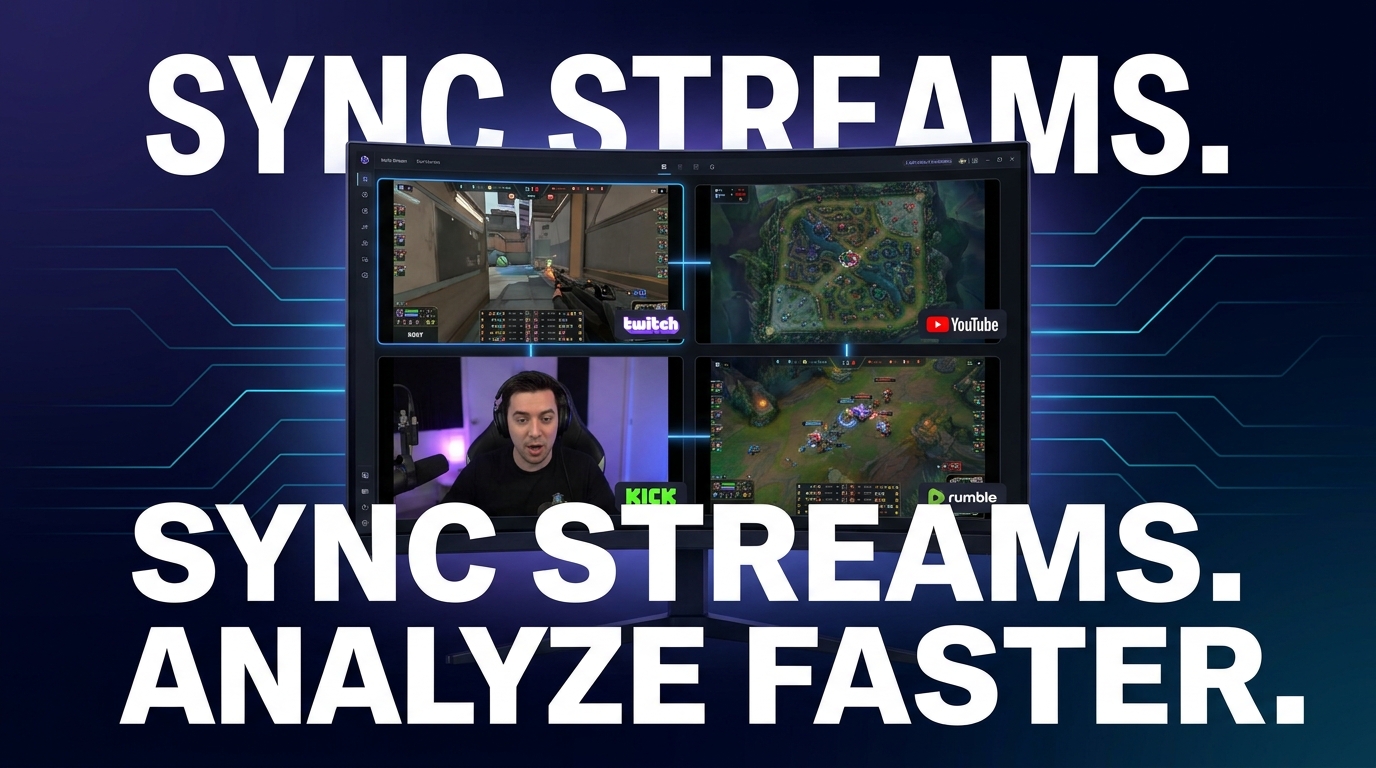
Alright, let's talk streams. Specifically, how we, the hardcore esports fans, actually get the full picture when everything's happening at once. Because let's be real, watching a big tournament, say a Valorant Champions Tour match or a crucial League of Legends Worlds series, from just one perspective? That's like trying to understand a symphony by only listening to the flute. You're missing so much.
I've been there, yelling at my screen – "Wait, what did that lurker just do on B site?", "Did anyone see that top laner's teleport timing?", "Is the IGL actually calling this or is it a solo push?" We crave the bigger picture. We want to see the main broadcast, sure, with all its fancy overlays and the commentators' hype. But we also need to see the star duelist's POV, the clutch support player's decision-making, or even just the raw comms from a team's official watch party. That's where the magic happens, that's where you truly understand the strategy, the individual skill, the sheer chaos of high-level play. This need to see everything, all at once, from different angles, is precisely why figuring out how to sync multiple live streams has become my personal obsession.
For ages, I'd fumble with browser tabs, trying to line them up. One Twitch tab, a YouTube tab for the official broadcast, maybe a Kick stream for a popular co-streamer. It's a mess. The audio clashes, the video drifts out of sync, and you spend more time trying to be a digital conductor than actually enjoying the game. And when you're talking about professional esports analysis, whether you're a casual fan just trying to learn or someone seriously breaking down VODs, that drift is a killer. It throws off timing, makes comparing plays impossible, and frankly, it just ruins the immersion. We need proper multi-stream synchronization, especially for those critical moments.
Why Synchronizing Streams Is Such a Headache
Look, it sounds simple, right? Just open a bunch of streams and press play. Ha! If only. The reality of live streaming is far more complex than that. You're dealing with a whole chain of events from the gamer's PC, through their encoder, to the streaming platform's servers (Twitch, YouTube, Kick, you name it), then through content delivery networks (CDNs), and finally to your device. Every single one of those steps introduces a tiny bit of delay. It's unavoidable.
And these delays aren't uniform, that's the kicker. A big Twitch streamer, let's say Shroud playing Apex Legends, might have slightly different latency settings than the official Apex esports broadcast on YouTube. Or maybe Tarik's co-stream of a VCT game on Twitch is running on a standard encoder setup, while the main VCT channel is using a dedicated, ultra-low latency ingest server. The result? You're watching two streams of the same exact moment in time, but one is consistently a few seconds, or even a dozen seconds, behind the other. It's maddening.
Last year, during the LEC Spring Finals, I was trying to watch the main broadcast alongside a couple of pro player POVs. The main broadcast showed a teamfight breaking out, and a few seconds later, on one of the player POVs, I'd then see the setup for that fight. It totally spoils the moment! The main broadcast often has some inherent delay added intentionally, too, to allow for referee review or to prevent stream sniping. Combine that with the variability of different platforms, different broadcasters, and even your own internet connection, and you've got a recipe for desynchronized chaos. It makes genuine esports multi-POV sync feel like a pipe dream sometimes.
The Latency Monster
So, what exactly causes this latency monster to rear its ugly head? It's a combination of factors, honestly. First off, there's the encoding delay. When a streamer plays a game, their computer has to take all that raw game footage, compress it, and turn it into a format that can be sent over the internet. This takes processing power, and thus, time. Even with powerful PCs and dedicated hardware encoders, there's a few milliseconds of delay baked in.
Then, that encoded video has to travel from the streamer's computer to the platform's ingest server. This is network latency – basically, how long it takes for data to travel across the internet. It depends on your location, the server's location, and the quality of your internet service provider (ISP). Once it hits the platform, there's processing delay. The platform needs to transcode the stream into different qualities (720p, 1080p, etc.) so viewers with different internet speeds can watch it. This adds more time.
Finally, the stream is distributed through CDNs to viewers globally. More network hops, more potential for delay. Broadcasters often try to reduce stream delay multi-view by using dedicated hardware, highly optimized encoding settings, and low-latency modes on platforms. But even when they do, a fraction of a second here, a second there, across multiple streams, can quickly snowball into significant desynchronization. It's a constant battle, and frankly, most platforms aren't built from the ground up to offer perfect, across-the-board synchronization for any stream you throw at them.
Current (Imperfect) Solutions and What They Miss
Okay, so we've established the problem. What have the big players given us to try and fix it? Well, they've tried, bless their hearts, but their solutions are often limited in scope or functionality.
Take Twitch Squad Stream, for example. It's a cool feature, conceptually. If four streamers decide to play together and go live, they can activate a Squad Stream. This puts all four of their POVs into one player, and Twitch even tries to synchronize them. It's great for what it is – watching a pre-arranged group of friends or teammates playing the same game, usually with shared comms. I've used it to watch my favorite friend groups run through phasmophobia or among us. But the limitations hit hard: you can only have four streams. They all have to be from Twitch. The streamers have to be actively in the squad together. You can't just pick any random Twitch streamer and combine them with another. And you definitely can't throw in a YouTube main broadcast or a Kick co-stream. It's a walled garden, and while nice for casual co-viewing, it's not designed for the kind of granular esports analysis we're chasing.
Then there's YouTube's Multiview. This one's even more niche, honestly. It's primarily rolled out for specific events, often sports like NFL Sunday Ticket, and mostly available on smart TVs and certain devices. It lets you watch up to four pre-selected streams. Again, limited in scope, limited to specific content, and critically, you can't just throw in any YouTube stream. You can't pull up three different Overwatch League POVs and the main broadcast. It's a curated experience, not a user-customizable, analytical tool. It's a step, sure, but a tiny one.
I've also dabbled with browser extensions. Oh, the browser extensions! There are a few out there that claim to let you open multiple streams in one window. Some work, briefly. Others are buggy as heck. You often find yourself wrestling with an outdated extension that suddenly stops working after a platform update, or one that clogs up your browser with ads, or worse, presents a security risk. Plus, none of them offer robust synchronization tools. You're still manually pausing and playing, hoping you hit the right moment. And the moment one stream buffers, everything goes out of whack. It's a Band-Aid solution at best, and frankly, I'm tired of digging through GitHub repos hoping to find something that someone made in their spare time two years ago that still functions. We need something more robust, more reliable, and built specifically for this purpose.
How to Sync Multiple Live Streams Like a Pro (ViewGrid.tv Style)
Okay, so you want to finally sync multiple live streams and get that god-tier esports analysis experience? This is where ViewGrid.tv really shines, and honestly, it's become my go-to. It offers the flexibility that other platforms and extensions just don't, especially when you're dealing with cross-platform content and the need for precision. This isn't just about putting streams side-by-side; it's about getting them to play nice together. This is where we aim for true multi-stream synchronization.
Here’s a practical, step-by-step rundown of how I usually set up my multi-POV viewing, whether it's for a Dota 2 International match, a CS2 Major, or even just some community-driven Minecraft event with multiple creators.
- Open ViewGrid.tv: First things first, head over to the ViewGrid multi-stream viewer. It's designed specifically for this kind of multi-view setup. You'll see a clean interface, ready for you to start adding streams.
- Gather Your Stream URLs: This is where you decide what you want to watch. Do you want the official Valorant Champions Tour broadcast from YouTube, plus TenZ's POV on Twitch, and maybe a community co-stream on Kick? Grab those full URLs from your browser's address bar. ViewGrid is fantastic because it's platform-agnostic – you can mix and match from Watch multiple Twitch streams, Watch multiple YouTube streams, or Watch multiple Kick streams. This flexibility is huge for esports, where official broadcasts are often on YouTube, but pro players heavily use Twitch.
- Add Streams to ViewGrid: On ViewGrid.tv, you'll find input fields (or sometimes a drag-and-drop area) to add your URLs. Paste each stream's URL into a new slot. As you add them, ViewGrid will load them into your custom layout. Don't worry about the layout perfectly yet; we'll adjust that.
- Arrange Your Layout: Once your streams are loaded, you can drag and drop them to arrange them however you like. Want the main broadcast front and center? Drag it to the biggest slot. Want specific player POVs in smaller windows around it? Arrange them. You can resize each window too. This level of customization for Watch multiple esports streams is a game-changer for analysis. I usually put the main broadcast in a larger top-center slot, then surrounding it with 2-3 specific player POVs from their individual channels. Sometimes I'll even add a stats page or a live map if I can find a reliable stream for it!
- Crucial Step: Manual Synchronization: This is the big one, and it's where ViewGrid gives you the power. Since, as we discussed, streams will have different inherent delays, you need to manually adjust them.
- * Choose a Reference Stream: Pick one stream that you want everything else to sync to. This is usually the main broadcast or the one with the lowest perceived latency. Let it play.
- Pause and Play: For each other* stream, hit pause. Then, as you watch your reference stream, look for a clear, identifiable moment. This could be a specific sound cue (like an ability being cast, a bomb plant sound, a commentator saying a team name), a visual cue (a health bar dropping, a kill feed update, a scoreboard flash), or a specific moment in a replay.
- * Execute the Sync: The instant that moment happens on your reference stream, immediately unpause your secondary stream. You'll have to repeat this for each additional stream. It takes a little practice, but you'll get a feel for it. You might need to pause and unpause a few times, making tiny adjustments. Think of it like tuning an instrument – you're trying to get them all to play the same note at the same time. This is really how you sync multiple live streams effectively.
- Audio Management: This is key. Trying to listen to four streams at once is a nightmare. ViewGrid allows you to mute individual streams. I usually keep the main broadcast audio on, or sometimes just one specific player's comms if they're particularly insightful. You can always unmute another stream for a moment if you want to hear a specific sound cue or commentator. Using a good pair of headphones helps immensely here, allowing you to focus on the primary audio source.
Using this method, I've managed to watch entire series with almost perfect synchronization across 3-4 streams. It's a vastly superior experience to the old tab-juggling days.
Pro Tips for Achieving Pixel-Perfect Sync
Getting that perfect esports multi-POV sync isn't always instant, especially with the real-time nature of live events. But there are a few things I've learned that really help nail it down.
Look for a Clear Audio or Visual Spike: Don't just pick a random frame. Find something definitive. A gun going off, a "First Blood" announcement, a commentator's sharp exclamation. These provide excellent markers. For CS2, the sound of the bomb being planted is gold. In League of Legends, a specific champion ultimate animation or a ping sound.
Small Adjustments, Repeatedly: If you unpause and realize a stream is still off, don't just wildly pause again. Try pausing for just a second or two, then unpausing. You're trying to nudge it forward or backward in tiny increments. It's more of an art than a science sometimes, but the precision makes all the difference. Sometimes I'll even pause all streams and then unpause them in quick succession if one has drifted significantly.
The Buffer Problem: Occasionally, a stream will buffer for a second or two. When this happens, it will throw your sync off. Unfortunately, there's not much ViewGrid or any platform can do about your internet or the source stream having a hiccup. The best approach is to re-sync that particular stream after it stabilizes. I've found that having a stable internet connection for myself helps reduce stream delay multi-view related issues on my end significantly.
Pre-Event Setup: If it's a really important match, I try to get my ViewGrid setup going 10-15 minutes before the actual game starts. This gives me time to load everything, arrange my layout, and get those initial syncs locked in during the analyst desk segments or countdown. It saves a lot of frantic fiddling once the action starts.
Beyond Esports: Other Uses for Multi-Stream Synchronization
While my heart belongs to esports, the ability to sync multiple live streams isn't just for watching pros frag out. The utility of a powerful tool like the ViewGrid multi-stream viewer extends far beyond the competitive gaming scene.
I've found myself using it for news events, for example. During a major breaking news story, sometimes different networks are covering it from slightly different angles, or have reporters at different locations. Being able to watch Watch multiple news channels at once, side-by-side, gives you a much more comprehensive and balanced perspective. One channel might focus on the political implications, another on the human interest side, and a third might have live drone footage. Synchronizing them means you're seeing the event unfold, not just disjointed narratives. It’s powerful for staying truly informed.
And for traditional sports? Oh, absolutely. If you're into football, basketball, or even F1, imagine watching the main broadcast with its commentary, but then also having a tactical camera POV, or a specific player's camera (if available), or even a stream from the team's official channel showing their bench reactions. For Watch multiple sports streams, this adds a whole new layer of analysis. Last year during the World Cup, I had the main broadcast on one screen and an international feed with different commentators on another. It was awesome to hear different perspectives on the same goal or foul.
Even for general content creators, the applications are there. If you're a streamer who collaborates often, or if you're watching a charity event with multiple segments, being able to see all the different participant streams at once, in sync, just makes the experience so much richer. It's truly about breaking down those artificial walls between platforms and creators to build your own ultimate viewing dashboard.
Why ViewGrid.tv Is Your Go-To for Multi-Stream Mastery
Honestly, after years of struggling with janky browser setups and limited platform features, discovering ViewGrid.tv felt like finding a cheat code. It's not just another multi-viewer; it's a solution designed for people who really want to control their viewing experience.
The biggest draw for me is the unparalleled flexibility. As I mentioned, you're not locked into one platform. Whether it's a major tournament on YouTube, a pro player's co-stream on Twitch, or an emerging content creator on Kick, you can bring them all into one place. This cross-platform compatibility is non-negotiable for serious esports fans who follow multiple games and creators. It’s what makes viewgrid stream sync so uniquely powerful.
Then there’s the customization. Drag-and-drop layouts, resizing windows – it sounds simple, but it makes a world of difference when you're trying to create an optimal viewing setup. I can prioritize the main broadcast, dedicate space to a specific player's POV, and still have a smaller window for a chat or a stats page. This isn't a one-size-fits-all solution; it's your solution, tailored exactly to how you want to watch.
And the manual synchronization capabilities are, frankly, revolutionary for this specific niche. It acknowledges the inherent latency issues of live streaming and gives you the power to correct them. It doesn't promise a magical, automated fix (because that's almost impossible in the current streaming landscape), but it gives you the tools to achieve it yourself, with precision. This is why I consider it the ultimate ViewGrid multi-stream viewer. It puts the control squarely back in the hands of the viewer, which, for an enthusiast like me, is priceless. It lets me get as nerdy as I want with my esports analysis, without fighting my own viewing setup.
Final Thoughts: Elevate Your Viewing Experience
If you’re anything like me – someone who lives and breathes esports, who dissects every play, every call, every clutch moment – then figuring out how to sync multiple live streams isn't just a nice-to-have; it's essential. It transforms your viewing from a passive experience into an active, analytical one. You move from simply watching the game to truly understanding it, from every angle.
The frustration of missing a key moment because one stream was ahead or behind is a thing of the past. With tools like ViewGrid.tv, you gain control, flexibility, and ultimately, a far richer, more immersive viewing experience. Stop juggling browser tabs. Stop missing crucial details. Give yourself the power to curate your own perfect esports (or news, or sports, or whatever you're into) broadcast. Trust me, once you experience synchronized multi-POV viewing, there’s no going back. It’s how I watch everything now, and my understanding of the games I love has only deepened because of it.
Ready to try multi-stream viewing?
Watch YouTube, Twitch, Kick & more — all on one screen.
Open ViewGridRelated Articles
Master Streamer Collabs: Multi-Stream Every POV
Tired of missing out on streamer collab POVs? Learn how to multi-stream your favorite creators from Twitch, YouTube, and Kick to get the full story. Your ultimate streamer event multi view guide is here!
how toMulti-Stream Sync: Keep Live Feeds Aligned
Tired of desynced streams? Learn why live streams get out of alignment & discover easy ways to sync multiple live streams for esports, news, and more, including how ViewGrid.tv helps.
how toCrypto & Stocks: Multi-Stream for Real-Time Edge
Unlock real-time market insights with multi-stream crypto stock analysis. Learn how to set up your ultimate trading multi-screen view for crypto and stock markets, leveraging multiple live streams for a competitive edge. Get ready to watch multiple crypto streams and make informed decisions.
how toMulti-Stream for Beginners: Your First Setup Guide
Tired of missing out? This guide breaks down how to watch multiple streams, from esports to news, using a streaming multi view app like ViewGrid.tv. Get your first setup running today!